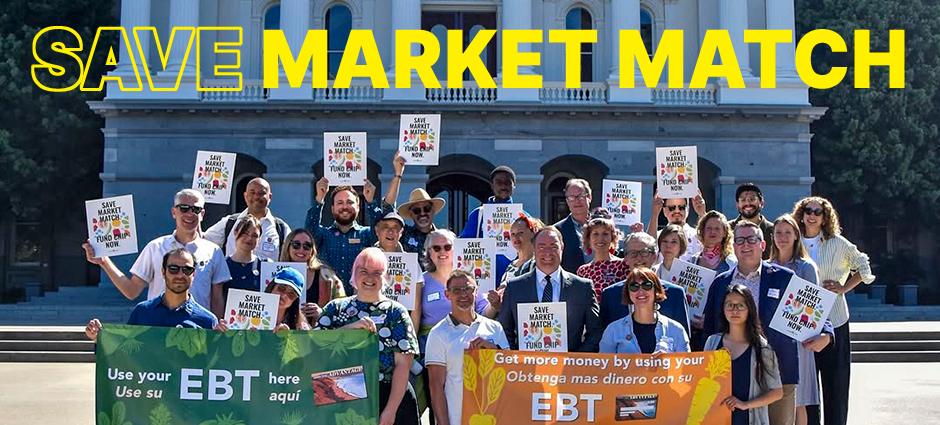
PCFMA Raises Concerns about Farm Bill
PCFMA's Executive Director, Allen Moy, recently met with U.S. Representative Mark DeSaulnier, who represents California's 10th Congressional District, to share concerns regarding the federal Farm Bill and its potential impact on small-scale farmers who rely on direct–to-consumer sales at farmers markets.
The federal farm bill is a massive, multi-year law, traditionally renewed every five years, that defines how the federal government supports and regulates food and farming in the U.S. While the Farm Bill had for decades been on a five-year renewal cycle, the most recent federal farm bill was passed 8 years ago. The 2018 Farm Bill was extended through September 30, 2026, to maintain funding for federal programs, and a new bill or an additional extension must be passed by September 30 to keep these essential programs operating.
Public reporting on the Farm Bill that passed out of the House Agriculture Committee in early March suggests it fails to address the significant cuts and changes to the federal SNAP program, provide adequate support for small-scale family farms, or bolster the farm-based environmental programs that are essential to the current administration’s goal to “make America healthy again.”
While there are many significant concerns with the current House version of the Farm Bill, there are three specific areas that we believe are the highest priority for farmers markets and the farmers who rely on those markets:
- Protect Funding for the Local Agricultural Market Program (LAMP)
LAMP is a program within USDA’s Agricultural Marketing Service and serves as an umbrella program for the Farmers Market Promotion Program (FMPP), the Local Food Promotion Program (LFPP), the Regional Food System Partnerships Program (RFSP), and the Value-Added Producer Grants (VAPG).
PCFMA has directly benefited from FMPP funding in the past and was recently awarded a “turnkey” grant to support marketing outreach in six PCFMA farmers markets, including the Martinez Farmers Market in Congressional District 10.
LAMP provides essential funding for farmers markets, small-scale farmers, and other food access organizations to support innovative programs and support their growth to increase their impact and ability to serve more farmers and consumers. Without this funding, farmers markets will struggle to sustain their roles as critical economic spaces where small-scale and beginning farmers and new food-based businesses can get their start.
- Support the “Reforming and Strengthening the Farmers Market Nutrition Program Act”
The Farmers Market Nutrition Program (FMNP) is the only federal food access program exclusive to farmers markets, unlike programs like SNAP and WIC, which can also be spent at grocery stores and other retailers.
The Act seeks to shift ongoing responsibility for FMNP to the Agriculture Committees in both the House and the Senate, creating baseline guaranteed funding for the program while reducing the current matching requirements that prevent some states from participating. It would also give states the option to expand eligibility to include low-income veterans, in addition to WIC–enrolled families and seniors.
FMNP is essential to ensure that farmers markets remain accessible and affordable for families at all income levels.
- Oppose any Attempts to weaken the Local and Fresh Food Requirements of the Gus Shumacher Nutrition Incentive Program (GusNIP)
GusNIP is a competitive grant program that funds financial incentives to SNAP/CalFresh customers. California has received four GusNIP grants totaling over $30 million over eight years to support matching programs.
Within the Farm Bill that recently passed out of the House Agriculture Committee are these sections:
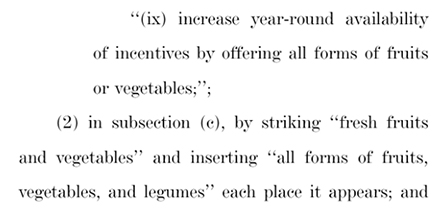
(SEC. 4303. Reauthorization of the Gus Schumacher Nutrition Incentive Program)
Section 4303 of the House version includes changes that, while appearing minor, seem intended to make grocery stores eligible for future GusNIP grant support. This would potentially push out the farmers markets that originally fought for the program's creation and remove the requirement that GusNIP funding be used to support U.S. farmers.
We strongly object to any attempt to dilute GusNIP’s original intent: directly support U.S. farmers and farmers markets.